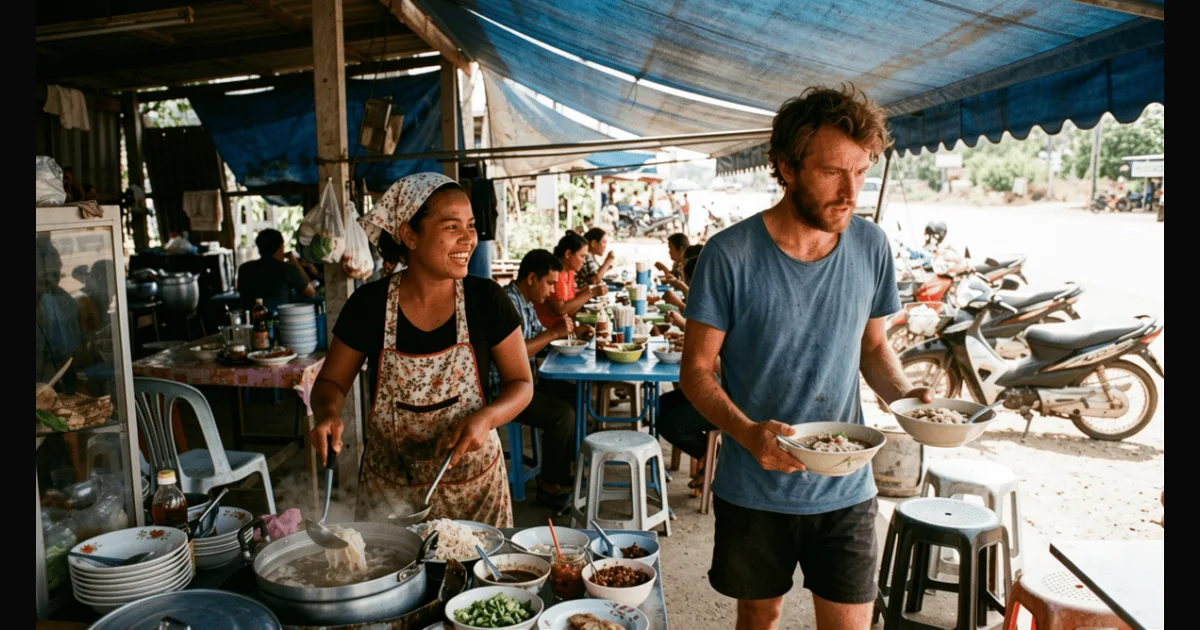
My motorbike broke down outside Korat, on the way to nowhere in particular. Ten years later, I still haven't left.
In short
Liam, a 29-year-old Irish backpacker with no fixed plan, gets stranded outside Korat when his motorbike breaks down next to a noodle stall. Nan, the 24-year-old owner, feeds him without asking. Ten years later they're still together, running the same stall.
I'm Irish, was 29 when this started, and had spent four months riding a motorbike around Southeast Asia with no plan beyond following wherever the road led each morning.
The bike broke down on the outskirts of Korat, on a side road with nothing recognisable in sight except a noodle stall with a couple of plastic tables under an awning. I pushed the bike the last five hundred metres in heat that felt personal at the time, and sat down to wait while someone from the village tried to track down a mechanic.
The stall was run by Nan, 24 at the time, who served Pad Mee Korat, the dry noodles with tomato and pork sauce the city is locally famous for without almost any tourist outside Thailand knowing it. She served me a plate without asking, seeing I hadn't eaten in hours, and sat with me a moment while I waited, more out of curiosity about the stranded farang than anything else.
The mechanic took three days to get the part my bike needed, ordered from Bangkok.
One Saturday, halfway through those three days, Nan's regular helper didn't show up because of a family emergency, and the stall got busier than I'd seen it up to then, with a line of badly parked motorbikes outside and impatient customers waiting for tables. Nan put me on cash and running plates without asking whether I knew how, shouting prices at me from the improvised kitchen whenever I hesitated. We closed that night exhausted, the till balancing almost perfectly, something that surprised us both equally. It was the first day I felt like I wasn't just a stranded farang waiting on a part, but someone who'd actually helped with something real. I spent those three days basically living at Nan's stall, clumsily helping with whatever I could — washing dishes, hauling rice sacks, entertaining the regulars with terrible Thai that everyone found funny — without anyone exactly asking me to, but without anyone telling me to stop either.
When the bike was finally ready, I didn't use it to leave. I used it to go back and forth from a cheap apartment I rented ten minutes from the stall, stretching what was supposed to be a three-day stop into weeks, then months, with no conscious decision involved at any point.
I asked Nan, almost two months after the breakdown, why she'd never kicked me out of the stall in all that time, given I wasn't actually much real help. She laughed and told me at first she'd felt sorry seeing me eat alone at the counter every night, and that later, without noticing, she'd stopped feeling sorry and simply started liking having me around.
Her family didn't have much in the way of expectations for me, for better or worse, because nobody in the village expected a 29-year-old Irish backpacker with a broken-down bike to stick around long enough for it to matter. Once it was clear I was actually staying, her mother put me to real work at the stall instead of letting me help as a joke, which I came to understand, over time, as the clearest form of acceptance that family had.
Ten years later, the noodle stall now has a small building with an actual roof instead of an awning, thanks in part to a loan we took out together five years ago that we're still paying off. Nan still cooks the same Pad Mee Korat, her mother's same recipe. I handle the accounts and, on weekends, a few short motorbike rides for passing tourists who stop to ask out of curiosity, the same curiosity that made me stop here once with absolutely no intention of staying.
Continue reading
Related stories
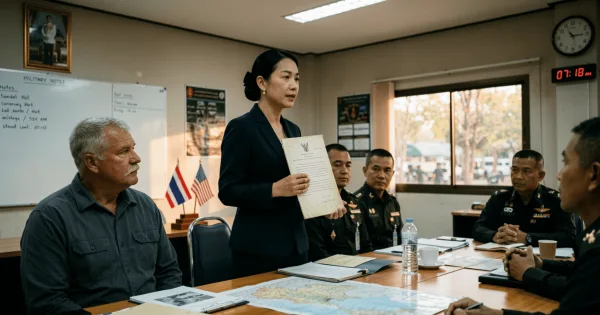
I worked coordinating joint exercises with the Thai army in Korat. The official who handled my paperwork ended up handling a lot more than that.
Frank, a 58-year-old American veteran, works as a civilian contractor coordinating joint military exercises in Korat, home to one of the Thai army's largest bases. Gift, the base's liaison official, becomes far more than an administrative contact.
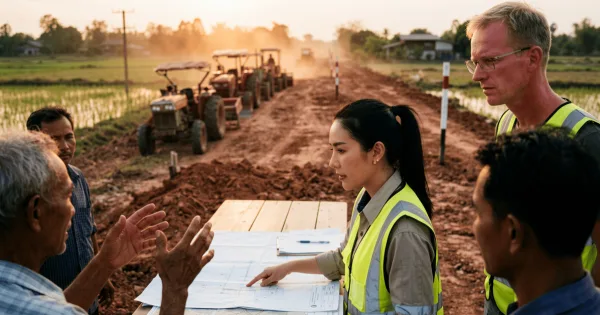
I came to Korat for eighteen months for a rail project. Six years later the project still isn't finished, and I've stopped wanting it to be.
Erik, a 44-year-old Dutch civil engineer, arrives in Nakhon Ratchasima for an eighteen-month contract on the high-speed rail project. He meets Mint, the project's liaison engineer and translator, and eighteen months turns into six years.
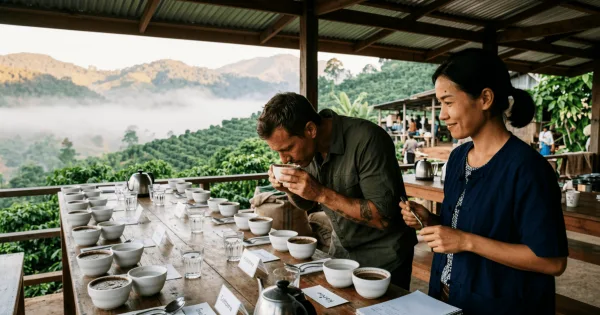
I came to Chiang Rai to buy coffee for a week. Eight years later, I still negotiate prices with the same cooperative, though now I'm also part of the family.
Sam, a 39-year-old Canadian coffee buyer, travels to Chiang Rai to negotiate with a cooperative in the Doi Chang mountains. Kaew, the quality-control manager, corrects him on a lot he thought was good. Eight years later they're still cupping coffee together, now as a married couple.

I gave up my accountant's job in Cardiff to go climbing in Krabi for two weeks. Five years later I'm still here, living with the woman who taught me to belay my first route.
Tom, a 34-year-old Welshman, takes three months' unpaid leave to climb at Railay, in Krabi. He falls for Fon, the Thai instructor running the climbing school, and five years later he's still there, making a living from climbing instead of accounting.
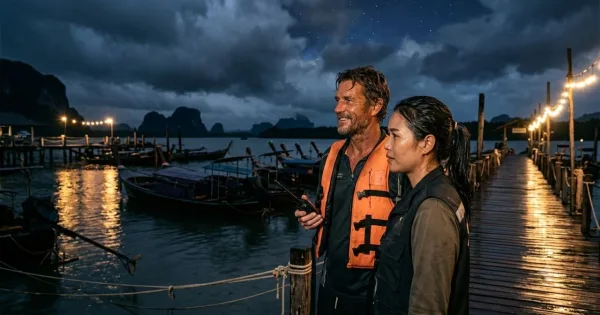
I sent customers to her boat every week without asking for anything back. It took her family two years to stop suspecting me.
Mark, a 46-year-old Australian who runs island tours out of Krabi, starts referring customers to Nam's boat company, a 36-year-old widow who inherited the family business. The relationship builds slowly, and it takes his in-laws two years to trust him.