Is it normal for a Thai partner to support her parents financially?
In short
Yes, in most cases: supporting parents financially is a deeply rooted family duty in Thai culture, especially for women from rural regions, and it doesn't stop once she's in a relationship or married to a foreigner. On its own, it isn't a warning sign — what matters is transparency, not the fact that support exists at all.
More context
This kind of support is less an exception than the norm in many Thai families, particularly where parents are older, live in a rural area like Isaan, or don't have another child nearby to rely on. It typically continues, sometimes even increases, once the couple marries and the foreign partner's finances become part of the household picture — though how much is reasonable, and when it starts looking like something else entirely, is a separate question we cover in our dedicated FAQ on that. What distinguishes ordinary filial duty from an exploitative pattern isn't the transfer of money itself, but whether it's discussed openly, tied to real needs, and free of urgency or secrecy.
Related questions
Does this financial support usually continue after marriage, or mostly during dating?
It usually continues, and can even increase, once the couple marries and pools finances more openly — dating-only support that stops abruptly after a breakup is more often the sign of a scam than the norm.
Does supporting her parents affect how much a couple can save for their own future?
It can, especially early on, but most couples factor it into their budget the same way they would any other recurring family expense once it's out in the open and both partners agree on the amount.
Is the support typically a fixed monthly amount, or does it vary depending on need?
Both exist: some households settle on a fixed monthly sum for predictability, while others prefer to cover specific needs as they come up rather than commit to a set figure.
Related stories

I kept coming back to Pattaya for thirteen years. In the third bar on Soi Honey I met Jib.
A 42-year-old Dutchman started visiting Pattaya in 2010 and never stopped coming back every January. In 2022, in a bar on Soi Honey, he met Jib, from Isaan. Two years later he bought land from her family, fully aware of what that meant.
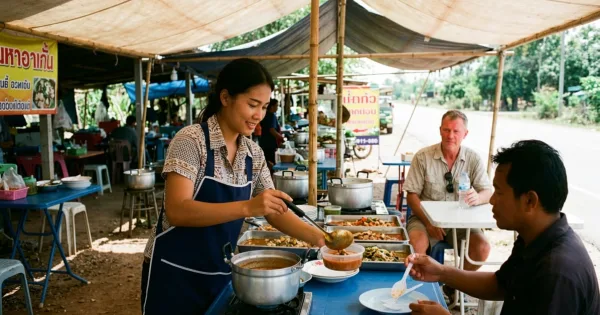
I gave her 400,000 baht and two years of my life. One day she went to a temple and never spoke to me again.
A 51-year-old Canadian recounts how he went from a tense relationship in Pattaya to supporting Lek for two years as she built a food stall in her village near Prakhon Chai, until she vanished without explanation after a temple retreat.
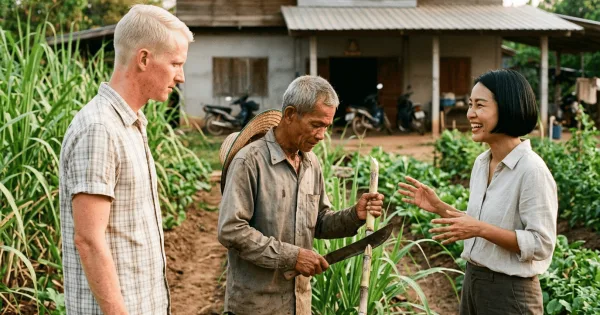
We shared a room with separate beds and her family wouldn't let me pay for a single meal. My last night, she chose to sleep somewhere else.
After seeing plenty of bar scams in Thailand, a Swedish man was introduced online to a woman from Isaan looking for something serious. Months of daily calls and a visit to her family later, the relationship never quite came together. It wasn't the love story he hoped for, and it wasn't a scam either.

The lockdown wiped out the businesses she'd spent twenty years building. She never once stopped calling me every morning and every night.
On a group tour of Thailand in 2019, an Irishman met a divorced woman running several small businesses on Koh Samui. Lockdown forced her to move back to Isaan, but they never stopped talking every single day. Years later, he's planning to propose on his next visit.
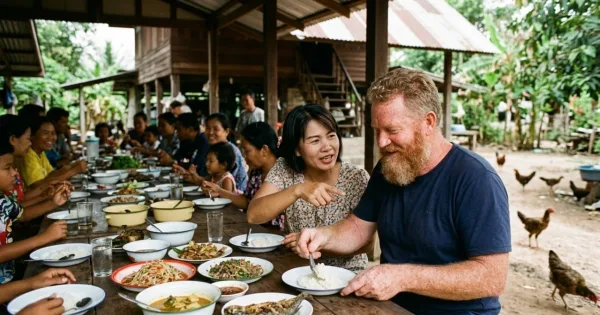
I went to Thailand on holiday after an eleven-year breakup in Scotland. Nineteen years later, I live with twelve in-laws under one roof.
Graham, a 51-year-old Scot, first came to Thailand at 32, on holiday after a long breakup. In the bars of Koh Samui he met Dao, the woman he'd later marry. Nineteen years, a Thai wedding, and a house built in Isaan later, he lives surrounded by her family and wouldn't change a thing.