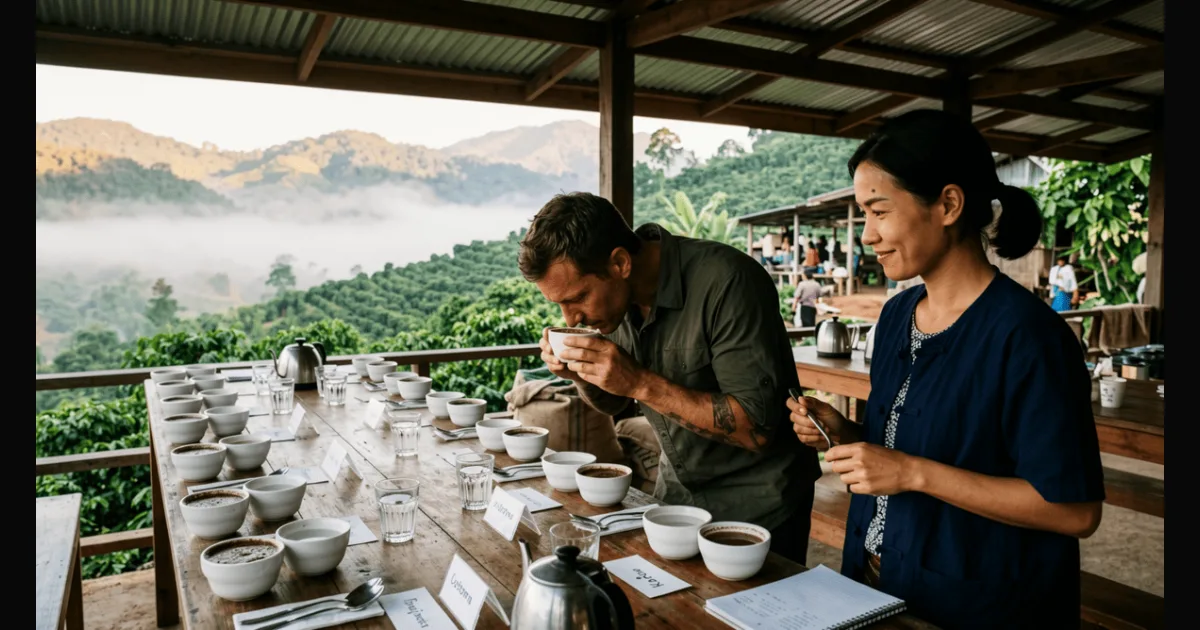
I came to Chiang Rai to buy coffee for a week. Eight years later, I still negotiate prices with the same cooperative, though now I'm also part of the family.
In short
Sam, a 39-year-old Canadian coffee buyer, travels to Chiang Rai to negotiate with a cooperative in the Doi Chang mountains. Kaew, the quality-control manager, corrects him on a lot he thought was good. Eight years later they're still cupping coffee together, now as a married couple.
I'm Canadian, 39, and I work buying single-origin specialty coffee for a roastery in Vancouver, a job that takes me travelling several times a year to coffee-growing regions around the world. Chiang Rai entered my route eight years ago, when my company got interested in the high-altitude arabica grown in the mountains of Doi Chang and Doi Tung, near the Myanmar border.
My first trip was supposed to last a week: visiting several farms, cupping samples, negotiating prices for the next harvest with local cooperatives. One of those cooperatives was run, on the quality-control side, by a woman named Kaew.
Kaew was 34 at the time, trained in agronomy in Chiang Mai, and she was the person who decided, before any sample ever reached my hands, which lots were even worth cupping. We argued, that first week, over an entire lot she refused to certify as export quality even though I, with a palate trained more in cupping rooms than on real farms, found it perfectly acceptable.
She was right, not me. The lot had a fermentation defect that only showed up after a darker roast than the one I'd tried at the first cupping. I admitted it openly in front of her whole team, which, she told me later, wasn't something foreign buyers did very often.
I came back three months later for harvest season, officially to oversee the drying process for the lots we had bought. Unofficially, to see whether Kaew was still as confident as I remembered. She was.
We spent that entire season basically together, cupping samples every morning before the heat set in, riding up to farms only reachable by motorbike on roads that became impassable during rainy season. She taught me to tell, by smell before taste, well-processed coffee from mediocre coffee. I taught her, with less success, some business English she needed to negotiate directly with buyers like me without relying on a middleman.
One afternoon that second season, a sudden storm turned the road down the mountain into an impassable mudslide, and we got stranded at the cooperative's highest farm, no phone signal, with only the farm owner and his family for company. We ate rice and a chicken slaughtered that same afternoon, slept on mats on the main room floor, separated by a makeshift curtain the family hung without anyone asking them to, and spent a good part of the night talking in whispers so as not to wake anyone, about nothing in particular and everything at once. We came down the next morning, mud up to our knees, and neither of us pretended anymore that it was just work.
I asked her, at the end of that second season, whether she'd want the relationship to be more than buyer and supplier. She laughed and told me she'd spent months avoiding the question herself, because mixing business and something personal in a small cooperative, where everyone finds out everything, seemed complicated.
We complicated it anyway. Her family, who've farmed the area for generations, received me with the same practical caution Kaew used when assessing a coffee lot: no instant warmth, plenty of quiet observation before deciding whether I was serious or just another passing foreign buyer.
Eight years later, I still buy coffee from that same cooperative, though the price negotiations now are considerably less formal than at the start, given that the person across the table is also my wife. We split our time between Chiang Rai and Vancouver, though I spend more of it here than there every year. I still haven't won a single blind cupping against her, eight years of trying.
Continue reading
Related stories
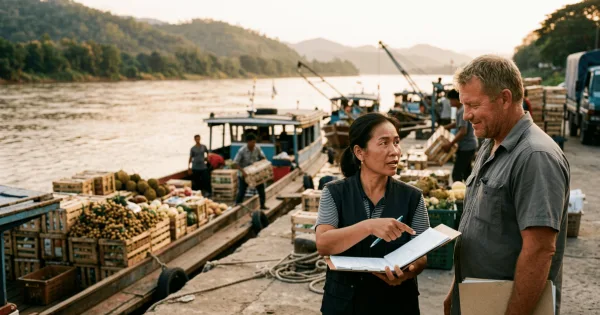
I coordinate logistics for Thai fruit exports to China along the Mekong from the Golden Triangle. She's been running that same port for fifteen years.
Nathan, a 50-year-old New Zealander, coordinates Thai fruit exports to China along the Mekong from the port of Chiang Saen, in the Golden Triangle. Orn, who's managed the port logistics for fifteen years, becomes something more than a work colleague.
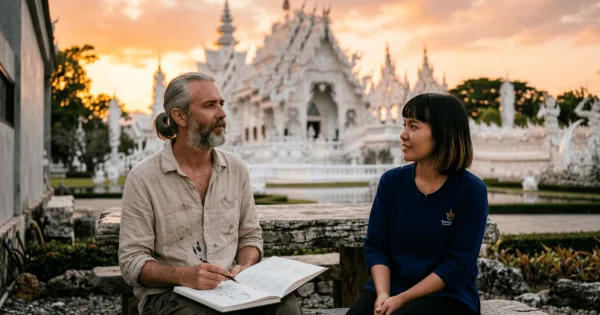
I went to the White Temple on holiday, just to take photos. I flew home two weeks later to actually pack my bags.
Alex, a 45-year-old British illustrator, visits Chiang Rai's White Temple on holiday. Bua, a guide and assistant at the associated gallery, notices his sketches. Five years later, Alex exhibits his own work in the city.
Six hundred thousand baht. Eighteen months. And a 29-year-old American I never met.
A retired teacher thought he was building a future with Lek. Eighteen months and six hundred thousand baht later, he learned who he was really funding.
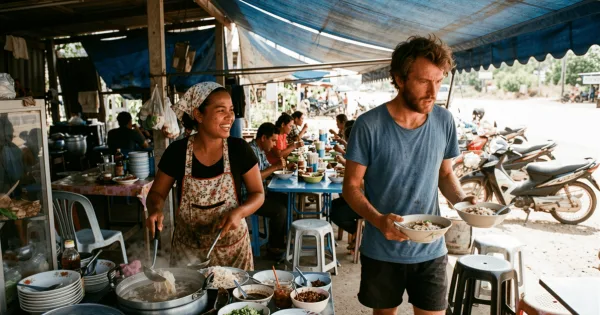
My motorbike broke down outside Korat, on the way to nowhere in particular. Ten years later, I still haven't left.
Liam, a 29-year-old Irish backpacker with no fixed plan, gets stranded outside Korat when his motorbike breaks down next to a noodle stall. Nan, the 24-year-old owner, feeds him without asking. Ten years later they're still together, running the same stall.
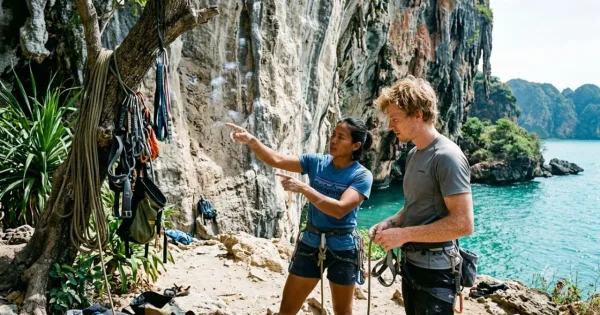
I gave up my accountant's job in Cardiff to go climbing in Krabi for two weeks. Five years later I'm still here, living with the woman who taught me to belay my first route.
Tom, a 34-year-old Welshman, takes three months' unpaid leave to climb at Railay, in Krabi. He falls for Fon, the Thai instructor running the climbing school, and five years later he's still there, making a living from climbing instead of accounting.