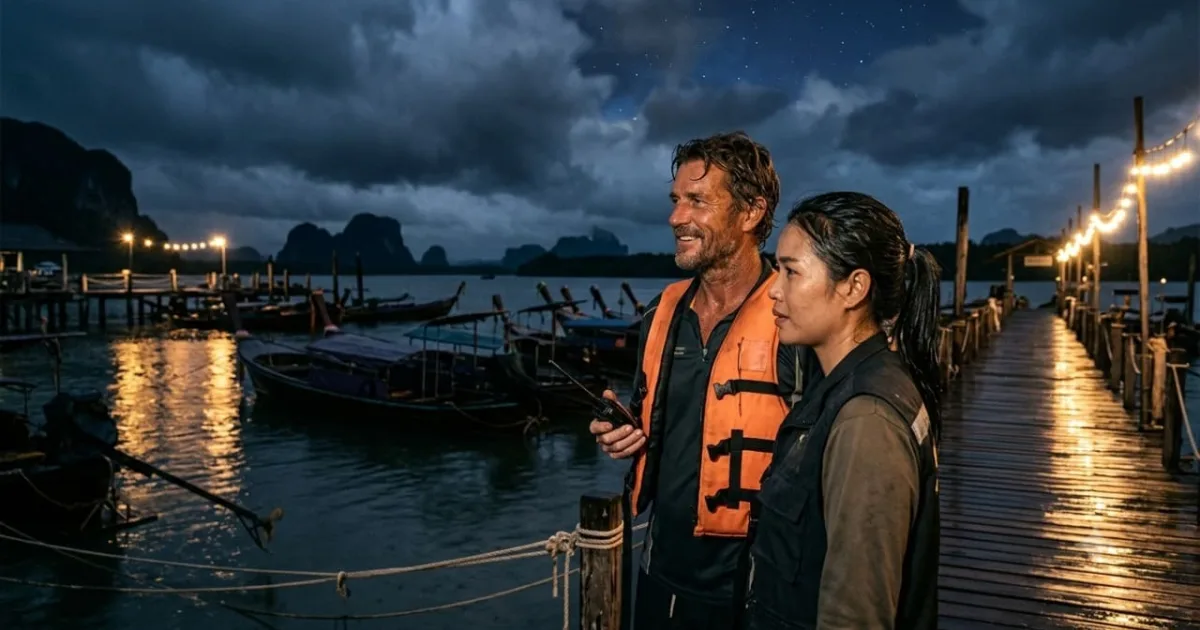
I sent customers to her boat every week without asking for anything back. It took her family two years to stop suspecting me.
In short
Mark, a 46-year-old Australian who runs island tours out of Krabi, starts referring customers to Nam's boat company, a 36-year-old widow who inherited the family business. The relationship builds slowly, and it takes his in-laws two years to trust him.
I'm Australian, 46, and I've lived in Krabi for eight years, taking tourists out by speedboat to the Phi Phi Islands and the Hong Islands almost every day of the year, except when the monsoon makes it impossible.
When I arrived, I subcontracted the bigger tours out to other companies because my own boat only held eight people. One of the companies I started working with was a family-run longtail boat business named after a late husband, run since his death by his widow, a woman named Nam, thirty-six years old.
We met through work, literally: me calling every morning to confirm how many customers I was sending her that day, her confirming boat and captain availability. For almost a year our relationship was exactly that and nothing more.
Nam's husband died in an accident at sea, not so different from the kind I myself avoid every day with safety protocols that sometimes strike me as excessive until I remember why they exist. He left behind three boats, an outstanding loan on two of them, and an extended family — her parents, her two brothers-in-law — with very firm opinions about how the business he'd built should be run.
Nam had been running the company alone for five years when I met her. She'd already paid off a good chunk of the loan, hired and fired several captains, and learned to haggle with fuel suppliers in market Thai that bore no resemblance to the polite Thai she'd used all her life until then.
I started sending her more customers than was strictly convenient for me, partly because her boats were reliable and her captains punctual, and partly, though it took me months to admit it to myself, because I wanted a reason to call her every morning.
One afternoon, still in that first year of pure work, a rainy-season storm blew up much faster than the forecast had said, with two of her boats and one of mine still out on the water, coming back from the Hong Islands with tourists aboard. We spent almost two hours on the radio and phone, her coordinating her captains and me mine, deciding together which route each boat should take to avoid the worst of the swell, with no clear hierarchy between us over who was actually in charge of that call. When all three boats docked safely, well after dark, we stood on the pier for a while without saying much, just the shared relief that no one had been hurt. Nothing happened that night, no romantic gesture, but for months afterward, every time we spoke, we both knew we'd been through something together that had nothing to do with boat logistics.
I told her after almost a year, in the least elegant way possible: I asked if she felt like having dinner with me on a day that wasn't about boat logistics. She went quiet for a long moment and then said she'd been waiting weeks for me to ask, because she wasn't going to be the one to bring it up, not with a business client in the mix.
Her family didn't take it well, at first. Her brothers-in-law especially made it clear over more than one family meal that a farang getting involved with their late brother's boat business sounded exactly like the kind of story they'd heard about other towns along the coast: foreigner gets involved with a widow, foreigner ends up with part of the business.
I don't blame them. I'd seen a couple of similar cases myself over eight years in the area.
I spent almost two years not asking for or accepting any role in Nam's company, not as a partner and not as an advisor, though I kept sending her customers every week just as before. When we finally decided I did want to invest in a fourth boat for the fleet, I insisted that everything be done through an independent Thai lawyer, with clear contracts spelling out what percentage was mine and what percentage remained with her late husband's family, and a meeting with her brothers-in-law where the lawyer explained every clause in Thai before anyone signed anything.
It was the most uncomfortable meeting of my life in Thailand, sitting at a plastic table across from two men who hadn't trusted me for two years, watching a lawyer read out loud exactly how much money I was putting in and what I'd be entitled to if Nam and I ever split up.
But it worked. Not because the paperwork changed how they felt about me — that took even longer — but because they saw with their own eyes that there was nothing hidden, no fine print, no quiet plan to end up with what her brother had built.
Today the fourth boat has my name and Nam's painted on the hull, in Thai and English. Her brothers-in-law invite me to family gatherings without Nam having to insist, and the older one, who objected the most at the start, is the one who asks me the most now about engine maintenance whenever something breaks down.
We still technically live apart, her in the family house where the business grew up and me in my apartment near the harbour, though I spend almost every night at hers. We haven't talked about marriage yet. After eight years in Krabi and two years of paperwork with lawyers, I've learned that here the important things don't always happen when you'd expect them to, but they happen when they're genuinely ready to, not before.
Continue reading
Related stories

I gave up my accountant's job in Cardiff to go climbing in Krabi for two weeks. Five years later I'm still here, living with the woman who taught me to belay my first route.
Tom, a 34-year-old Welshman, takes three months' unpaid leave to climb at Railay, in Krabi. He falls for Fon, the Thai instructor running the climbing school, and five years later he's still there, making a living from climbing instead of accounting.

I fell asleep without locking my phone on the last night of the holiday. She saw my Line history, and that was the end of it.
A 54-year-old Frenchman meets Amara, a 39-year-old chef, on his first day in Phuket, and within 24 hours he already has a holiday girlfriend. Months later, in Koh Samui, an unlocked phone reveals his Line history to her: dozens of conversations with other girls that put an end to something that, until that night, had been genuinely special.

I dodged financial disaster with Charm. With Gop and her daughter I ended up as Papa without ever planning it.
A 54-year-old American recounts how a two-week trip to Thailand stretched on indefinitely: first dodging a woman with escalating financial demands, then building a life in Bangkok alongside Gop and her daughter, who ended up calling him Papa.

350 guests, a village chief consulting his charms for the date, and years later a message asking for a divorce.
A 50-year-old Australian recounts how a 350-guest Thai wedding in Phuket turned into a guest house in Patong, an affair with another woman, bar fights involving the police, and a final message asking for a divorce.

Om never asked me for a penny in two years. Now she runs Thai nights at our pub.
A 26-year-old Brit met Om in a bar on Soi Buakhao, Pattaya, then found her again months later serving coffee off Beach Road. Two years of her never asking for anything, a complicated visa and a wedding later, they now run a pub in England with Thai theme nights.