Chiang Rai Guide
In short
Chiang Rai is northern Thailand's coffee, art, and river-trade province, calmer and less developed than Chiang Mai. The three stories on this site set here — a Canadian coffee buyer, a British painter drawn by the White Temple, and a New Zealand logistics coordinator on the Mekong — all describe foreigners who came for a specific trade and stayed for a Thai woman met directly through that work: correcting a coffee lot, judging a sketch, solving a customs problem. None starts in a bar; all three start with shared, skilled work.
Chiang Rai is Thailand's northernmost major province, calmer and less developed than Chiang Mai two hours south, built around cool-climate agriculture, a distinctive contemporary art scene anchored by the White Temple, and Golden Triangle river trade with China along the Mekong. All three stories on this site set here follow the same shape: a foreigner arrives for a specific, often unglamorous reason — buying coffee, sketching a temple, coordinating fruit exports — and stays because of a Thai woman met through that exact work, not around it. See also our Long Distance and Family topic pillars for the patterns that follow once these relationships settle in.
What's it actually like here?
Chiang Rai sits in Thailand's far north, bordering Myanmar and Laos at the point locals call the Golden Triangle, historically the center of the regional opium trade and now a legitimate river-trade hub between China and Southeast Asia along the Mekong. The province's cooler mountain climate supports coffee and tea farming at altitude — Doi Chang and Doi Tung are internationally known specialty-coffee regions — and its most famous single site, the all-white, mirror-covered Wat Rong Khun (the White Temple), has made it a genuine draw for artists as well as tourists. Unlike Chiang Mai, it has never developed a large permanent expat or nightlife scene; most long-term foreigners here are tied to a specific trade, craft, or industry.
Relationships & everyday life
The three stories on this site set in Chiang Rai all follow foreigners who came for something specific to the province rather than the province itself. A Canadian specialty-coffee buyer, sourcing arabica from the mountains around Doi Chang, falls for the quality-control manager at the cooperative who first corrected his palate rather than flattering it. A British illustrator, visiting the White Temple purely to sketch, is noticed by a guide at the associated art gallery, and never fully returns to his old career. A New Zealand logistics coordinator, managing fruit shipments to China along the Mekong from the Golden Triangle's river port, falls for the woman who has run that same port's logistics for fifteen years, tested by a drought that stranded barges for weeks. None of the three describes nightlife, a bar, or an app: all three describe a shared task — grading coffee, judging a sketch, keeping cargo moving — that became the actual foundation of the relationship.
Practical aspects
Chiang Rai's long-term foreign residents cluster around a handful of specific trades tied to the province's real economy: coffee and tea buying, art, and cross-border river trade, rather than retirement or tourism services. That means relationships here tend to start through sustained, repeated contact around shared work — a harvest season, a gallery, a customs office — rather than a single encounter, and two of the three stories on this site that describe meeting the woman's family show the same pattern as the rest of the Isaan and northern guide: quiet, practical scrutiny before acceptance, earned through demonstrated competence and reliability in the shared work itself, not through gestures or money.
Frequently asked questions
What is Chiang Rai known for?
Mainly three things: the all-white Wat Rong Khun (White Temple) and its associated contemporary art scene, specialty coffee and tea grown in its mountains (Doi Chang and Doi Tung), and the Golden Triangle, the river-trade point where Thailand, Myanmar, and Laos meet along the Mekong.
Is Chiang Rai the same as Chiang Mai?
No — they're different provinces, about two hours apart. Chiang Rai is smaller, calmer, and less developed for tourism and expat life than Chiang Mai, with an economy built more around coffee, tea, art, and river trade.
Based on these stories, how do relationships in Chiang Rai typically start?
Through sustained shared work rather than a single meeting — a coffee harvest season, a temple art gallery, a customs office — according to all three stories on this site set here.
Is the Golden Triangle still known for the opium trade?
Historically, yes — but the real river traffic through Chiang Saen today, as one of the stories on this site describes, is mostly fruit, electronics, and general goods traded between China and Southeast Asia.
Stories in Chiang Rai
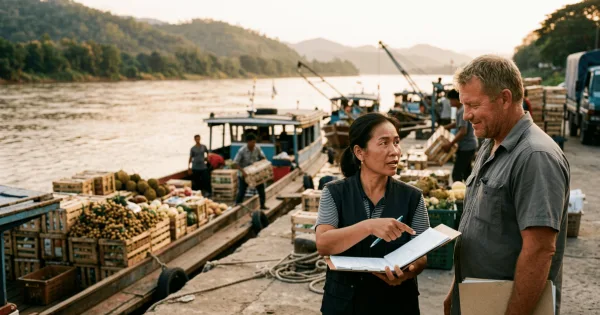
I coordinate logistics for Thai fruit exports to China along the Mekong from the Golden Triangle. She's been running that same port for fifteen years.
Nathan, a 50-year-old New Zealander, coordinates Thai fruit exports to China along the Mekong from the port of Chiang Saen, in the Golden Triangle. Orn, who's managed the port logistics for fifteen years, becomes something more than a work colleague.
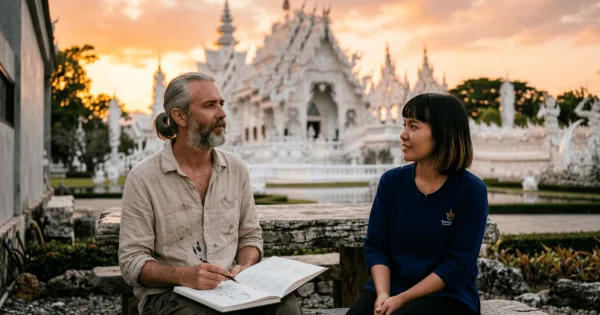
I went to the White Temple on holiday, just to take photos. I flew home two weeks later to actually pack my bags.
Alex, a 45-year-old British illustrator, visits Chiang Rai's White Temple on holiday. Bua, a guide and assistant at the associated gallery, notices his sketches. Five years later, Alex exhibits his own work in the city.
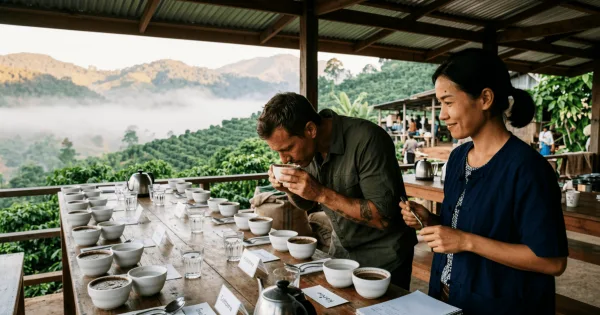
I came to Chiang Rai to buy coffee for a week. Eight years later, I still negotiate prices with the same cooperative, though now I'm also part of the family.
Sam, a 39-year-old Canadian coffee buyer, travels to Chiang Rai to negotiate with a cooperative in the Doi Chang mountains. Kaew, the quality-control manager, corrects him on a lot he thought was good. Eight years later they're still cupping coffee together, now as a married couple.
A trip to Vietnam taught me to tell lust from love. I went back to Thailand, met a woman 24 years younger than me, and I'm about to propose.
A 52-year-old Canadian, after mistaking lust for love on a trip to Vietnam, goes back to Tinder looking for something real and meets a Thai woman of Chinese descent 24 years younger than him. Three weeks together across Bangkok, Pattaya and Koh Samui become the start of a long-distance relationship that, bumps and all, is still going strong toward a proposal.
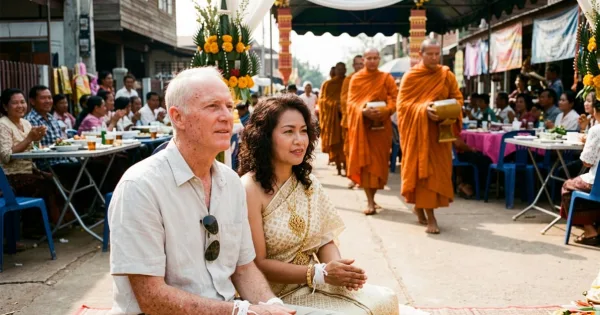
I opened a joint account with the million-baht dowry. She started quietly withdrawing money without telling me.
A 62-year-old retired American recounts how he met Dada at a Pattaya massage shop, married her in a Buddhist ceremony in Isan, and everything fell apart when she started quietly withdrawing money from the joint account he'd opened for the dowry.
Six hundred thousand baht. Eighteen months. And a 29-year-old American I never met.
A retired teacher thought he was building a future with Lek. Eighteen months and six hundred thousand baht later, he learned who he was really funding.