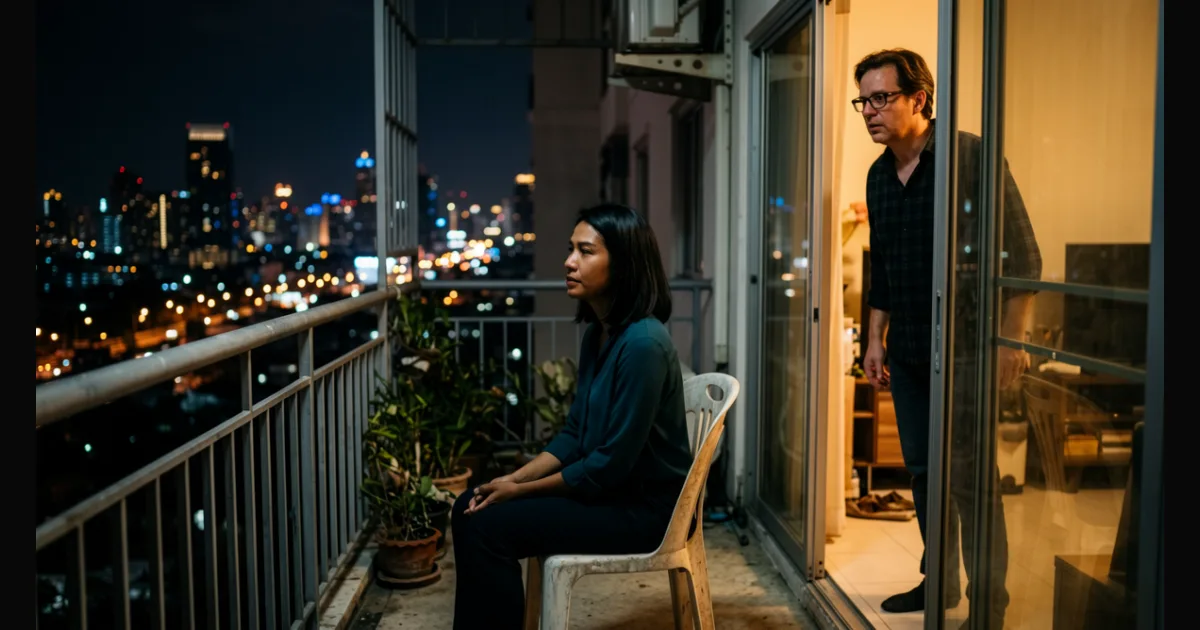
Someone stole my motorbike right in front of her and she just shrugged it off. It took me a year to understand that it wasn't that she didn't care — she just carried it differently.
In short
Marcus, a 41-year-old German, gets frustrated when his Thai partner Fern responds with a calm 'mai pen rai' after his motorbike gets stolen. It takes him a year to understand the phrase doesn't mean indifference, just a different way of carrying a problem.
I'm German, 41, and I've lived in Bangkok for five years, working in logistics for a European shipping company with a regional office here. I met Fern, 34, three years ago, at a work meeting where she was interpreting for a local supplier.
The first time I really saw the difference in how we process problems was the day my motorbike got stolen outside a 7-Eleven, while she waited inside with the shopping bags. She came out, saw the empty spot where the bike had been, and said, with the same calm she'd have used to comment on the weather, "mai pen rai, we'll buy another one."
I was furious. I wanted to call the police, file a report, check the 7-Eleven's cameras, find whoever did it. She let me do all of that, without opposing it, but also without any real urgency, and when after three days with no leads I asked her whether she cared at all, she went quiet for a moment and told me of course she cared, it was our money, but staying angrier wasn't going to bring the bike back.
For months, that struck me as an elegant way of not facing things. We argued about it more than once, me accusing her of indifference, her not quite knowing how to explain that her calm wasn't the absence of feeling.
The shift came, almost a year later, when it was her turn to have a real problem: a client from her translation work refused to pay her nearly forty thousand baht for a big project. I watched her process it exactly the same way as the bike — "mai pen rai," moving on, no drama — but that time, when I got home, I found her crying quietly on the balcony, with no intention of me seeing it.
I asked her why she hadn't told me that directly instead of with that public-facing calm. She explained that mai pen rai doesn't mean it doesn't matter, just that showing anger to someone who can't fix it doesn't help — and that crying alone on the balcony was, for her, exactly that: feeling it for real, without turning it into someone else's problem.
After that, I learned to tell the difference between her genuine mai pen rai — small setbacks, a stolen bike, a broken plan — and the silences that followed a mai pen rai said too quickly, which were the ones that actually needed a follow-up question.
We bought another bike, a used one, three weeks after the theft. She still rides it most of the time. I still don't fully understand how she manages not to get angry about small things, but I've stopped mistaking it for not caring.
Continue reading
Related stories

The German embassy asked me for a DNA test to recognise my own son. It took four months, and for that whole stretch my son legally didn't exist for any country except Thailand.
Felix, a 41-year-old German, discovers that legally recognising his son born in Bangkok, since he and the mother, Ploy, weren't married, requires a DNA test demanded by the German embassy before citizenship and a passport can be processed.

I arrived in Bangkok convinced I would be the one helping her. I was wrong.
A British man arrived in Bangkok carrying every prejudice about Thai women intact. What he found instead was a woman who did not need saving at all.

I went to Bangkok to see the world. In Chiang Mai I found something I was not looking for.
A 45-year-old American arrived in Thailand with no plan at all. In a small Chiang Mai café, one genuine smile changed the entire course of his life.

I dodged financial disaster with Charm. With Gop and her daughter I ended up as Papa without ever planning it.
A 54-year-old American recounts how a two-week trip to Thailand stretched on indefinitely: first dodging a woman with escalating financial demands, then building a life in Bangkok alongside Gop and her daughter, who ended up calling him Papa.

For a few hours I felt like the most interesting man in the room. It took me a while to understand why.
For a few hours, a 62-year-old American felt like the most interesting man in the room. It took him a while to see what was really behind it.