Money
In short
Money touches almost every story on this site — dowries, remittances, shared expenses, and in the worst cases, scams built entirely around financial requests. The income gap between countries creates a real asymmetry from the start; transparency about it early on is the healthy pattern in our stories, while escalating, unexplained requests are the same signal that shows up in scams.
Money runs through almost every story on this site, for better and worse: dowries, family remittances, shared expenses, and in the worst cases, scams built entirely around financial requests. This guide tackles head-on a topic many couples prefer to avoid until it's already too late. For the specific case of ongoing monthly support with no wedding involved, see our Sponsor Arrangements guide.
What does this actually mean?
In a relationship between a foreigner and a Thai woman, there's usually a real economic asymmetry from the start, given the income gap between countries. That isn't a problem in itself, but it shapes dynamics that don't exist in the same way in same-country relationships: who pays for what, how much is expected as contribution to the extended family, and how shared savings or property are managed. These conversations often come into sharper focus around Marriage, when dowry and family-support expectations become explicit.
Common patterns
A common healthy pattern is transparency: talking openly about income, expenses and family expectations from the start, including financial help to the partner's parents, which is no longer seen as optional but as part of the relationship in most cases documented here. The problematic pattern, by contrast, usually includes escalating money requests, lack of transparency about what the money is used for, and resistance to any conversation on the topic — signs that also show up in the most serious scams.
Practical advice
Establishing clear communication about finances from the start, understanding the economic context of the partner's family — especially if it's from a region like Isaan — and learning to tell a reasonable request for family support apart from a warning sign are the keys to managing money in a healthy way in these relationships.
Frequently asked questions
Who typically manages finances in these relationships?
It varies a lot by couple, though a common pattern is for each person to keep some financial independence while agreeing on joint contributions for shared expenses and family help.
Does a big income gap between partners cause tension in the relationship?
It can, especially if left unspoken: what each partner considers a large or small amount of money often differs, leading to friction unless both are explicit about expectations early on.
How do you tell a healthy financial pattern from a problematic one?
Transparency is key: a healthy pattern involves open communication about amounts and reasons; a problematic one includes escalating requests, constant urgency, and resistance to explaining.
Is it more common to send money regularly, or only for specific emergencies?
Both patterns exist and neither is more suspicious than the other: some families receive a small fixed amount monthly, while others only ask when a genuine need comes up.
Stories about Money
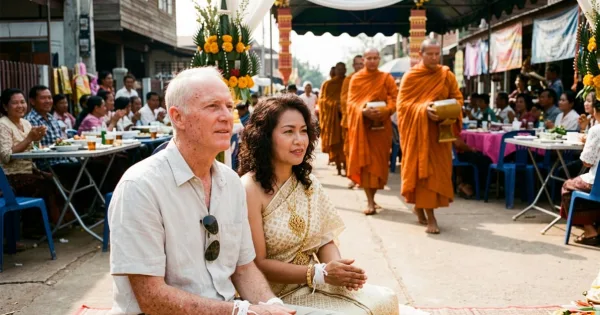
I opened a joint account with the million-baht dowry. She started quietly withdrawing money without telling me.
A 62-year-old retired American recounts how he met Dada at a Pattaya massage shop, married her in a Buddhist ceremony in Isan, and everything fell apart when she started quietly withdrawing money from the joint account he'd opened for the dowry.
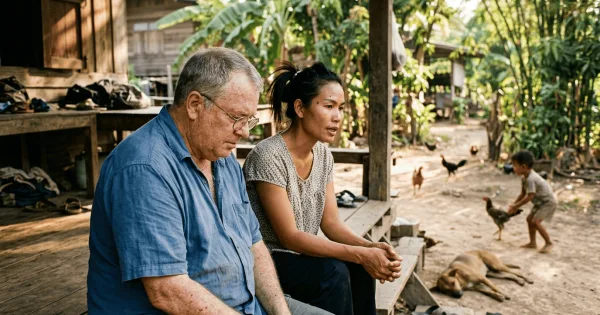
She called it being her boyfriend. Over time I realised I was actually her sponsor, one of several.
A recently retired American looks back on his relationship with a Thai woman he met in Hong Kong. What began as a romance with visits to Bangkok turned into a growing list of monthly payments, until he discovered he wasn't the only man supporting her.

I'd been going to Thailand for fifteen years and thought I knew it all. One game of pool in Pattaya proved me wrong.
At 39, an Australian who considered himself a seasoned Thailand traveller met a girl over a game of pool in a Pattaya bar. Ten perfect days, a golf tournament in Indonesia, visits to her family in Isaan. All good until six months of distance for work uncovered that the Scottish boyfriend she said she'd left had never actually gone anywhere.

He almost sent 400,000 baht. The only good decision he made was not to.
A 41-year-old British man went in two weeks from a Soi 4 fling to talking dowry and house renovations. He almost sent 400,000 baht. He did not.

An Australian messaged me to say the woman I'd fallen for was his girlfriend of a year. Today she's my wife.
At 44, divorced for a decade, an American meets Tay on Facebook. A month later, already in love, he finds out she'd spent the past year with an Australian man who'd visited her village in Isan. She confesses everything honestly and asks for one chance. Years later, they're married and building a house to retire in.

I kept coming back to Pattaya for thirteen years. In the third bar on Soi Honey I met Jib.
A 42-year-old Dutchman started visiting Pattaya in 2010 and never stopped coming back every January. In 2022, in a bar on Soi Honey, he met Jib, from Isaan. Two years later he bought land from her family, fully aware of what that meant.