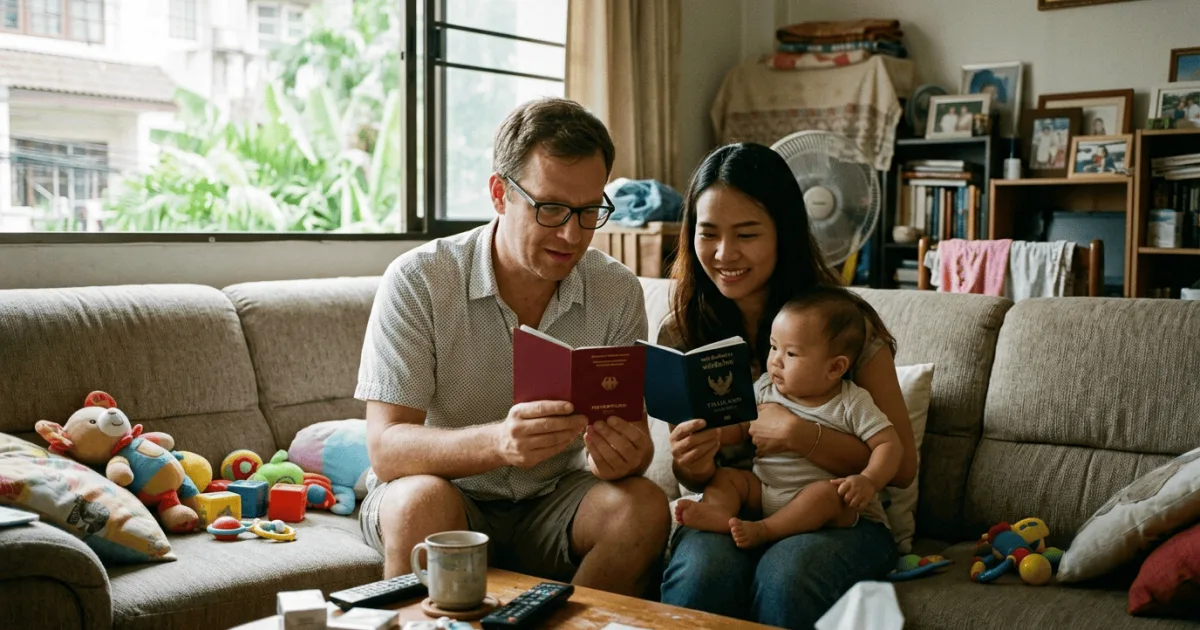
The German embassy asked me for a DNA test to recognise my own son. It took four months, and for that whole stretch my son legally didn't exist for any country except Thailand.
In short
Felix, a 41-year-old German, discovers that legally recognising his son born in Bangkok, since he and the mother, Ploy, weren't married, requires a DNA test demanded by the German embassy before citizenship and a passport can be processed.
I'm German, 41, and my Thai partner, Ploy, 29, had our son Ben at a private hospital in Bangkok. We weren't married at the time, something that in a lot of countries doesn't change the process much, but in the German case turned out to be the detail that complicated everything else.
As a father not married to the mother, Germany doesn't automatically recognise paternity just because my name appears on the Thai birth certificate. I had to legally acknowledge Ben before the German embassy, a process that, they explained, normally requires a DNA test when there's no marriage involved.
The DNA process itself wasn't technically complicated: an appointment at an authorised clinic in Bangkok, samples taken from Ben and me, sent to a certified lab in Germany for analysis. What was hard was the wait, nearly four months in total between the appointment, the shipment, the analysis, and the official confirmation.
During those months, Ben had a Thai birth certificate and nothing else. He couldn't apply for his German passport, or his consular ID number, until the paternity acknowledgment was settled, test result in hand.
Ploy took the wait more calmly than I did, reminding me several times that Ben had plenty of Thai nationality through her side and was never really going to end up without a country, though I struggled not to dwell on worst-case scenarios, especially while we were planning a trip to Germany for my parents to meet him.
When the confirmation finally arrived, with the result we expected, the rest of the process (German nationality registration and the passport) moved along fairly quickly, just a few more weeks.
Ben now has a German and a Thai passport, and met his German grandparents on a trip we took six months later than we'd originally planned. What stuck with me most from the whole experience is how important it is, for any foreign father in the same situation, to ask their own embassy from day one exactly what paternity proof they require when the parents aren't married, rather than assuming the Thai certificate is enough on its own.
Continue reading
Related stories
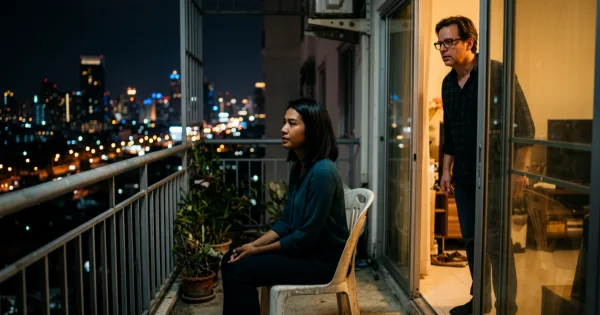
Someone stole my motorbike right in front of her and she just shrugged it off. It took me a year to understand that it wasn't that she didn't care — she just carried it differently.
Marcus, a 41-year-old German, gets frustrated when his Thai partner Fern responds with a calm 'mai pen rai' after his motorbike gets stolen. It takes him a year to understand the phrase doesn't mean indifference, just a different way of carrying a problem.

I arrived in Bangkok convinced I would be the one helping her. I was wrong.
A British man arrived in Bangkok carrying every prejudice about Thai women intact. What he found instead was a woman who did not need saving at all.

I went to Bangkok to see the world. In Chiang Mai I found something I was not looking for.
A 45-year-old American arrived in Thailand with no plan at all. In a small Chiang Mai café, one genuine smile changed the entire course of his life.

I dodged financial disaster with Charm. With Gop and her daughter I ended up as Papa without ever planning it.
A 54-year-old American recounts how a two-week trip to Thailand stretched on indefinitely: first dodging a woman with escalating financial demands, then building a life in Bangkok alongside Gop and her daughter, who ended up calling him Papa.

For a few hours I felt like the most interesting man in the room. It took me a while to understand why.
For a few hours, a 62-year-old American felt like the most interesting man in the room. It took him a while to see what was really behind it.