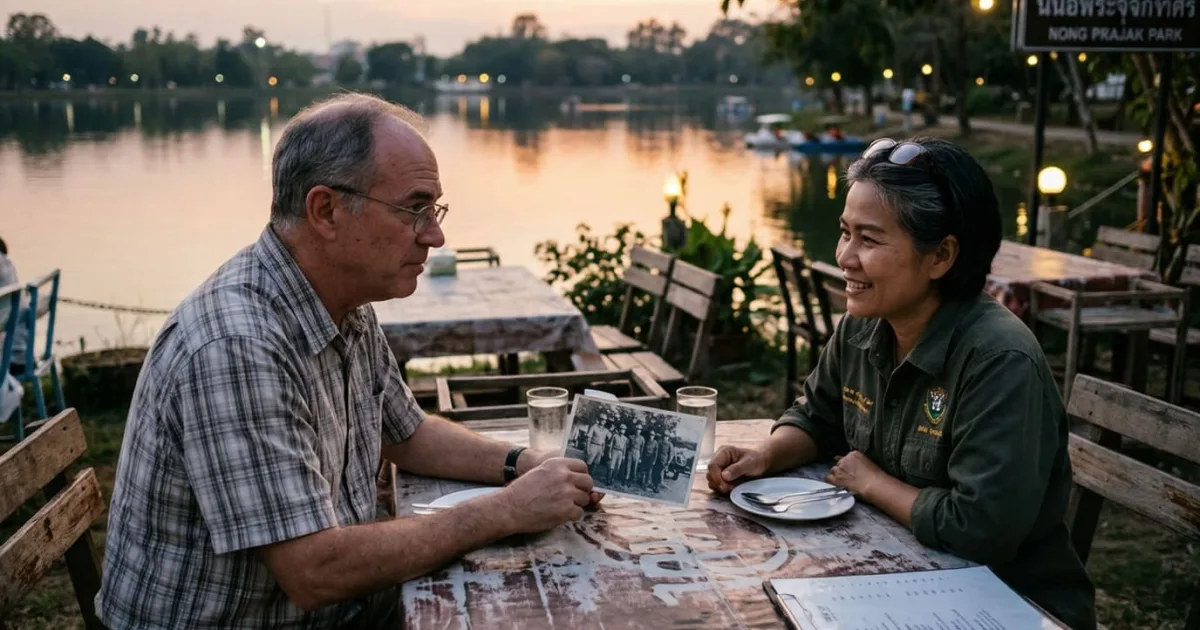
My father was stationed at Udorn airbase in 1969. I went to Udon Thani looking for a family I didn't even know existed.
In short
Robert, a 58-year-old American, travels to Udon Thani after his father's death, an air force mechanic once stationed at the old Udorn base during the Vietnam War, looking for traces of a life his father never talked about. Nid, a local researcher, helps him trace temple records, and something more grows along the way.
My father died when I was twenty-two, having told me almost nothing about the two years he spent stationed in Thailand with the American air force, between 1968 and 1970, a mechanic at the Udorn base, near what's now Udon Thani.
What little I knew came from loose fragments: a black-and-white photo of him next to a cargo plane, a story he told once, already drunk, at a family barbecue, about a Thai woman he called simply "her" and never gave any more detail about. My mother, whom he married after coming back to Ohio, knew about that story and tolerated it the same quiet way she tolerated almost everything my father never fully told.
I was 58 when I finally decided to go looking for answers, two years after my mother had also died, the last person who could have given me any real context. All I had to start with was the name of the base — Udorn Royal Thai Air Force Base, closed for decades now — and a Thai surname handwritten on the back of that one photograph: Somsri.
I was staying at a hotel in Udon Thani when someone at reception recommended I contact Nid, a 45-year-old woman who'd spent years helping American veterans and their children trace stories from that era, almost as an informal job that had accumulated on top of her over the years — half researcher, half translator, half something I still don't know how to name.
Nid told me, the first afternoon we spoke, with a frankness I appreciated more than I expected, that most of these searches don't end anywhere clean. Lost records, temples that no longer exist, families who moved away or would rather not stir up that past. She said she'd help anyway, but not to expect a tidy ending.
We spent a week and a half going through temples that used to register births, talking to elderly people who still remembered the base when it was active, some with fondness for those years, others with a bitterness they didn't try to hide. One man in his late eighties remembered a tall American mechanic who fixed motorbikes for extra money on weekends, though he couldn't say for sure whether it was my father or any of the hundreds of others who passed through there.
We found a 1969 birth record for a woman named Somsri, no father's surname specified, in a village on the outskirts of the city. The woman had died more than a decade ago, a neighbour confirmed. She'd had a daughter who, if the numbers lined up, would now be living somewhere in Bangkok, though nobody in the village could tell us exactly where.
It wasn't the tidy ending I'd been quietly hoping for, without admitting it to myself. No sister opened a door and recognised my father's face in mine. Just a name, a date that lined up unsettlingly well, and a trail that got colder the harder we pulled on it.
Nid watched how much that hit me, more than I'd expected myself, one afternoon sitting outside a temple after another dead end. She told me sometimes the search is all you get, that not every family story closes with a clear answer, and that doesn't make it any less real or any less worth having done.
I stayed in Udon Thani longer than I'd planned, officially to follow up two last leads that ultimately went nowhere, unofficially because I didn't want to stop seeing Nid yet.
We started having dinner together without the search being the excuse anymore, talking about her own family — her grandmother had worked cleaning at the base, something Nid herself only found out once she started this kind of work — and about mine, about a father who took a story to his grave I could only ever half reconstruct.
I asked her, one night, whether she thought it was strange that the search for my father's family had ended with the two of us sitting at a restaurant by Nong Prajak Lake, in no hurry for dinner to end. She laughed and said that in Udon Thani, with so much American history buried under the ordinary city people see today, maybe it wasn't so strange after all.
I never found Somsri's daughter. I might still find her one day, or I might not. But I found a city I hadn't expected to find, a woman who knew that history better than I did, and a reason to stay that had nothing to do with my father and everything to do with what happened after I stopped looking for him.
Continue reading
Related stories
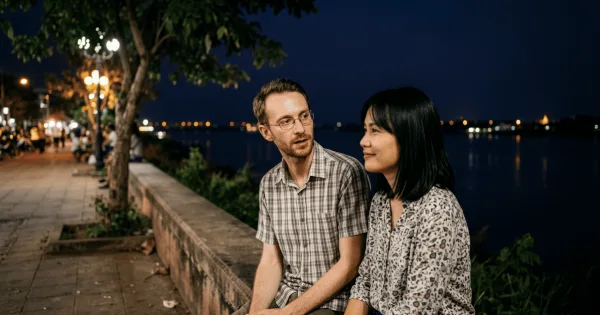
They sat us at the same staffroom desk because there was nowhere else free. Two years later, she's the reason I never asked for the transfer to Bangkok.
Daniel, a 35-year-old British teacher, moves from Bangkok to a bilingual school in Udon Thani. He ends up sharing a staffroom desk with Waan, a social studies teacher, by pure furniture chance. Two years later, he turns down a promotion in Bangkok for her.

I came to Udon Thani for a two-week hip surgery. The nurse who cared for me those two weeks is now my wife.
Peter, a 62-year-old Australian, travels to Udon Thani to have hip surgery at a private hospital, avoiding the long public waiting list back home. Ploy, the head nurse on his ward, becomes far more than his carer during recovery.
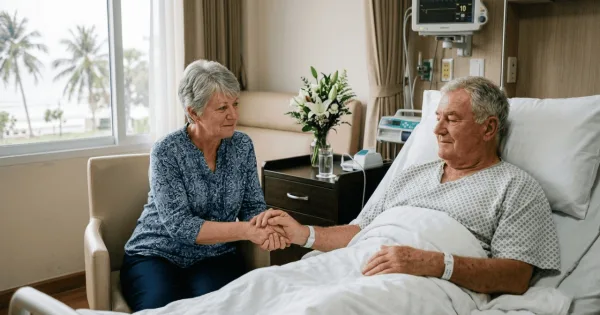
I only got the health insurance because the retirement visa required it. Eight months later, that mandatory paperwork was the one thing that stopped a heart attack from wiping me out financially.
Graham, a 68-year-old British retiree, reluctantly takes out the mandatory health insurance for his retirement visa in Hua Hin. Months later, a heart attack teaches him why the policy he saw as a formality turned out to be the most important decision he made moving here.
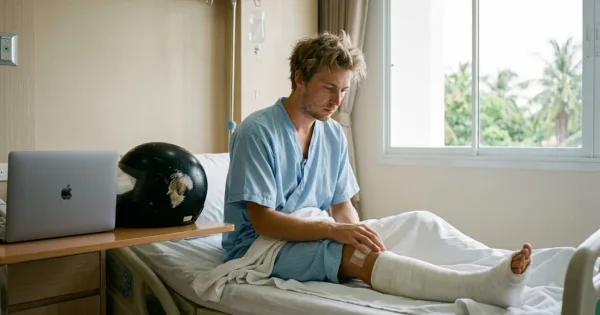
I was 27 and felt invincible, so I never bothered with health insurance. A motorbike accident on Koh Samui taught me exactly what that feeling of invincibility costs, in baht and in loan interest.
Jordan, a 27-year-old Canadian working remotely from Koh Samui, never saw the need for private health insurance. A motorbike accident leaves him with a hospital bill that takes over a year to finish paying off.
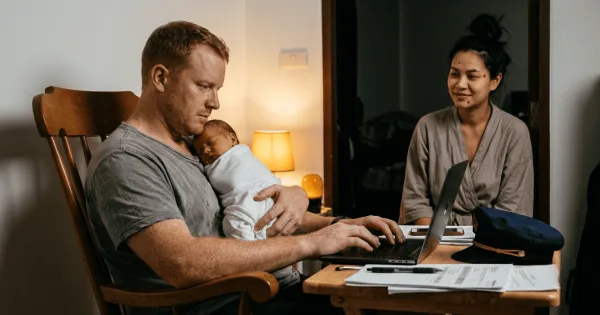
Our daughter was born in Chiang Mai on a Friday afternoon, and by Monday we were already arguing over which surname would go on each of her two passports.
Mark, a 34-year-old Canadian, and his wife Nam navigate the weeks following their daughter's birth in Chiang Mai, racing against the separate deadlines of the Canadian embassy and the Thai civil registry to secure her dual nationality.