I ate alone at her noodle stall every night for four months. By the time we finally talked, her kids had already decided I was a problem.
In short
James, a 60-year-old Scottish widower, retires to Hua Hin for the golf and starts eating dinner every night at the same noodle stall by the pier. It takes him four months to exchange more than two sentences with Nok, the owner, and much longer to win over her children, who've already heard too many stories about retired farang like him.
I came to Hua Hin because a friend from Edinburgh told me the golf was cheap and the climate wouldn't kill me in winter. It wasn't much more complicated than that.
I'm Scottish, 60 years old, and I'd been a widower a little over a year when I packed my bags. My wife, Fiona, died of pancreatic cancer nine months after the diagnosis, and by the time I finally sold the house I had no idea what to do with the rest of my life. A friend from the golf club had been retired in Hua Hin for years and wouldn't stop pushing. I finally went, mostly to get him to stop sending me photos of the green at seven in the morning under a sun we never see in Scotland even in July.
I rented a small apartment ten minutes' walk from the beach and settled into a routine that, looking back, was fairly bleak: golf in the morning, lunch alone, a nap, dinner alone, sleep.
I started eating at a noodle stall by the pier because it was on my way home from the club. It was run by a woman in her mid-forties, serious, efficient, who never smiled at customers automatically the way some tourist-facing places do. Her name was Nok.
I ate there, without exaggeration, more than a hundred nights in a row.
I never said more to her than "thank you" and "the usual, please." She never said more to me than the price and, some nights when it rained, "careful, it's slippery."
My golf buddy Gordon, who has that very British habit of poking his nose where it doesn't belong, asked me one day why on earth I ate at the same place every night if I'd never exchanged a full sentence with the owner. I told him the food was good. He told me I was an idiot.
He was right.
The next time I went, instead of sitting down and waiting in silence, I asked her how long the stall had been open. She stopped for a second, as if surprised I'd asked her a question that wasn't about the bill.
Eighteen years, she said. Her husband set it up; he died in a motorbike accident when the kids were small. She'd run it alone ever since, with her sister's help on the busy weekends.
I told her I was a widower too. I don't know why I said it so bluntly, but something about how she'd told her own story made it easy.
From that night on, we started talking a little each time I went. Never much — her working, me with my clumsy Thai and her with English learned serving tourists for two decades — but a little more each night than the last.
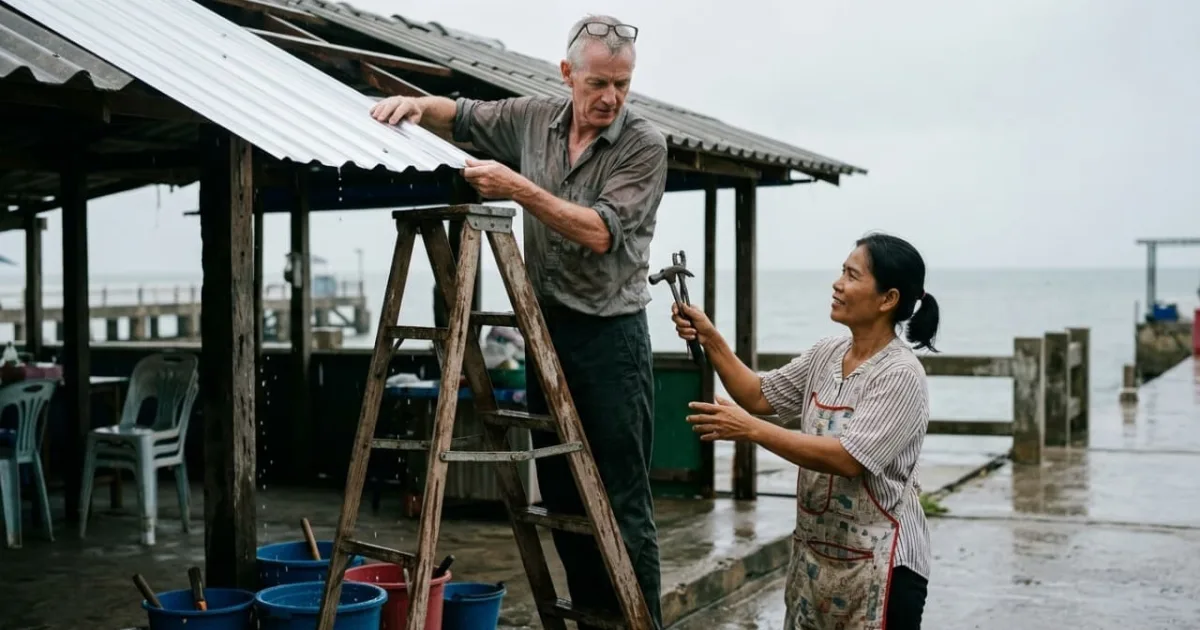
One day during the rainy season, the stall's tin roof started leaking right over where the customers sit. Nok was swearing in Thai while setting out buckets everywhere, and without thinking too much about it, I told her I'd come back the next day with tools.
She laughed, the first time I'd seen her really laugh. She said she didn't need a retired farang fixing her roof.
I came back anyway.
It wasn't elegant. I spent the afternoon up a borrowed ladder, soaked through, while she passed me sheets of new tin and shouted instructions in a mix of Thai and English I understood more from gestures than words. When we finished, she invited me to eat for free for the first time in four months.
I hadn't done it to impress her. I did it because my hands were free that afternoon and it seemed like the normal thing to do. But I think something between us shifted that day.
It wasn't only the kids, at first. One afternoon I overheard, without meaning to, the neighbour from the next stall telling Nok, in Thai, to be careful: that retired farang show up, promise things, and after three years get tired, get sick, or just leave, leaving the woman with half-finished renovations and debts she never asked for. Nok told me herself, weeks later, without any drama, as a fact she felt she had to put in front of me if this was going to be serious. I told her I understood, that I'd heard similar stories before, and that the only proof I could offer her was time, not a promise.
Her children were a different story, and that one took longer to settle.
Ploy is twenty-three and works in Bangkok. Ton is twenty and still lives in Hua Hin, helping at the stall when he's not in class. Both grew up hearing the same rumours you hear in any beach town in Thailand about men like me.
Ton, especially, didn't make it easy. The first time I had dinner with all three of them, he barely looked at me. He asked me flat out whether I planned to take over his mother's stall once she got older.
I told him I had no interest in the business whatsoever. That I had my pension, my apartment, and that if Nok ever needed help with something I'd give it, but that the stall was hers and her brother's, not mine.
I don't know if he believed me that night. But I kept coming for dinner. I kept fixing things when they needed fixing — once the roof, another time the fan motor, another time I helped Ton fill out an English-language scholarship form — never asking for anything in return, not once.
After a year, Ton started sitting with me without Nok having to ask him to.
We married two years after that first conversation about the roof, at the noodle stall itself, on a Sunday they closed to the public.
There was no temple, no monks, no two hundred guests. Nok didn't want that version of a wedding, and honestly, neither did I. Her regulars came, some of whom had been eating there longer than I'd been in Thailand. Gordon came too, in an appalling Hawaiian shirt he insisted on wearing.
Ton gave a toast. It was short, awkward, in English that had improved enormously in two years, and it ended with him saying his mother had spent eighteen years serving noodles to strangers, and that for once, he was glad a stranger had stayed.
It wasn't the most elegant speech I've ever heard. It's the one that's mattered to me the most.
I still go to the stall almost every night. I don't eat alone anymore, obviously, and now I know exactly when it's going to rain by how the air settles before a storm — something Nok taught me to recognise without words, just by pointing at the sky those first few times.
Fiona would have hated the heat here, if I'm honest. But I think she'd have liked knowing I didn't stay alone eating noodles forever.
Continue reading
Related stories
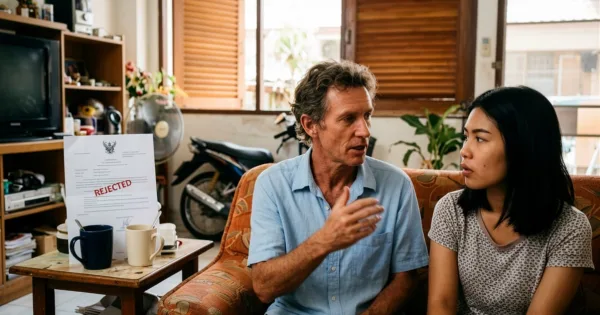
The reason for the visa rejection nearly made my head explode: she couldn't pronounce my name.
A 55-year-old Australian recounts how, after walking out of a relationship in Hua Hin in a bad mood, he wandered into the most boring looking bar in town and met the woman he'd marry in Perth years later, after a visa rejection for the strangest reason.

I only got the health insurance because the retirement visa required it. Eight months later, that mandatory paperwork was the one thing that stopped a heart attack from wiping me out financially.
Graham, a 68-year-old British retiree, reluctantly takes out the mandatory health insurance for his retirement visa in Hua Hin. Months later, a heart attack teaches him why the policy he saw as a formality turned out to be the most important decision he made moving here.

I told her I wouldn't send a single baht until we met in person. She accepted without arguing.
A 61-year-old American recounts how, after a failed relationship in Vietnam, he met May, a refreshingly honest Thai civil servant. Years of video calls and a temple wedding in Kanchanaburi with nearly 50 blessing strings later, he gained an entire family.

I opened a joint account with the million-baht dowry. She started quietly withdrawing money without telling me.
A 62-year-old retired American recounts how he met Dada at a Pattaya massage shop, married her in a Buddhist ceremony in Isan, and everything fell apart when she started quietly withdrawing money from the joint account he'd opened for the dowry.

A widower for ten years, I promised a stranger I'd come back. That's how I met Newt.
A 64-year-old New Zealander widower recounts his last three nights in Koh Samui with Newt, a woman he met by chance after keeping a promise made to another girl on the street. No drama, no requests, just company at exactly the right moment.