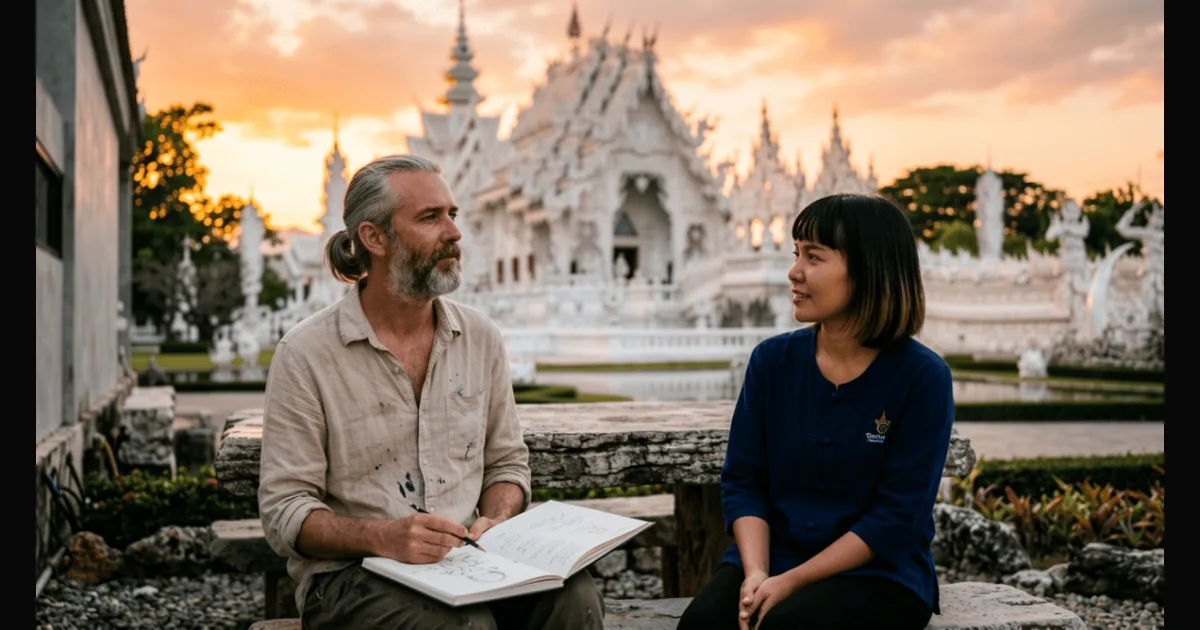
I went to the White Temple on holiday, just to take photos. I flew home two weeks later to actually pack my bags.
In short
Alex, a 45-year-old British illustrator, visits Chiang Rai's White Temple on holiday. Bua, a guide and assistant at the associated gallery, notices his sketches. Five years later, Alex exhibits his own work in the city.
I'm a painter, British, 45, and had a modest but stable career illustrating children's books in Bristol when I decided to take a three-week holiday around Southeast Asia, the first real holiday I'd let myself have in years.
I came to Chiang Rai just for the White Temple, Wat Rong Khun, because I'd seen photos online that looked almost impossible: an immaculate white Buddhist temple covered in tiny mirrors, sculptures of hands reaching up from the floor of hell, and a walkway to the entrance surrounded by statues unlike anything I'd seen before in more traditional Thai temples.
I spent the whole day there, sketching in a small notebook I always carried, with no concrete intention beyond having visual reference for some future project.
Bua worked as a guide and assistant at the contemporary art gallery attached to the temple, where the artist himself who designed the complex, Chalermchai Kositpipat, still exhibits new work. She saw me drawing in a corner, longer than a passing tourist usually draws, and came over to ask, in careful English she'd learned studying art in Chiang Mai, whether I was an artist or just a very patient tourist.
I showed her the notebook. She stayed looking at the sketches longer than I expected, pointing out which proportions I'd got right and which I hadn't, with the same blunt directness she, I found out later, used on her own students.
I came back to the temple the next three days, each time with the excuse of finishing a sketch I'd actually already finished the first day. Bua had breaks between tour groups, and those breaks kept stretching, from ten minutes to half an hour, and from half an hour to her simply waiting for me at the entrance before I'd even arrived.
On the last day of my original holiday, sitting on a bench outside the gallery watching the sun set over the temple's mirrors, I told her I didn't know how I was going to go back to Bristol to illustrate children's books about rabbits after this. I didn't say it as a declaration, more as a thought out loud. She asked me flat out whether that meant I was coming back.
I came back six weeks later, with a leave of absence sorted from work and a suitcase considerably bigger than my holiday one. I had no concrete plan beyond painting and finding out whether whatever this was with Bua was real or just the effect of a well-used holiday.
It was real. We spent the first year basically living between her apartment in the city and whole days at the temple and its surroundings, me painting landscapes I'd never had in front of me before, her translating conversations with other local artists who at first eyed me with the logical caution toward a farang claiming to work in art, until they started seeing my work hanging, months later, in a small gallery downtown.
Her family, farmers from an area nearby better known for tea than coffee, took a while to understand exactly what I did, given that "children's book illustrator turned Thai landscape painter" isn't a profession that explains itself easily in a second language over a family meal. What they did understand quickly was that Bua was happier than they'd seen her in years, something her mother told me directly, without Bua there to translate or soften the sentence.
Five years later, I'm still painting in Chiang Rai, now with my own work exhibited in two galleries in the city and a small reputation among collectors looking for something other than the usual tourist art. Bua still works at the temple gallery, though now also on weekends at my own studio, discussing my sketches with the same bluntness as that first day. I never quite made peace with the rabbit books I left half-finished in Bristol. Doesn't look like I'm going to.
Continue reading
Related stories
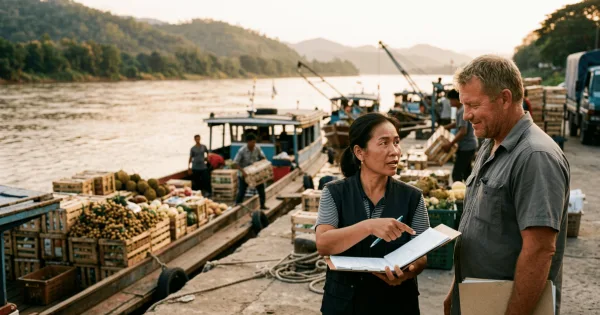
I coordinate logistics for Thai fruit exports to China along the Mekong from the Golden Triangle. She's been running that same port for fifteen years.
Nathan, a 50-year-old New Zealander, coordinates Thai fruit exports to China along the Mekong from the port of Chiang Saen, in the Golden Triangle. Orn, who's managed the port logistics for fifteen years, becomes something more than a work colleague.
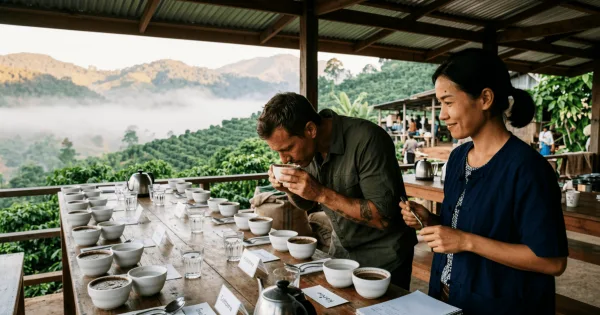
I came to Chiang Rai to buy coffee for a week. Eight years later, I still negotiate prices with the same cooperative, though now I'm also part of the family.
Sam, a 39-year-old Canadian coffee buyer, travels to Chiang Rai to negotiate with a cooperative in the Doi Chang mountains. Kaew, the quality-control manager, corrects him on a lot he thought was good. Eight years later they're still cupping coffee together, now as a married couple.
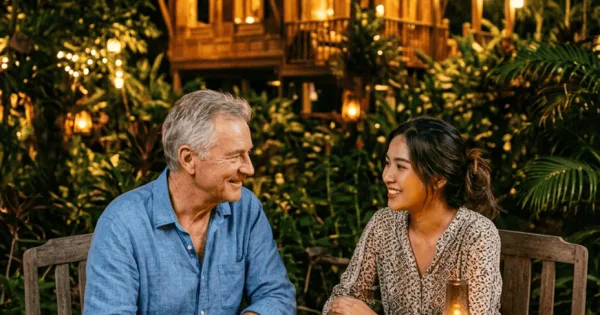
Six hundred thousand baht. Eighteen months. And a 29-year-old American I never met.
A retired teacher thought he was building a future with Lek. Eighteen months and six hundred thousand baht later, he learned who he was really funding.
I only got the health insurance because the retirement visa required it. Eight months later, that mandatory paperwork was the one thing that stopped a heart attack from wiping me out financially.
Graham, a 68-year-old British retiree, reluctantly takes out the mandatory health insurance for his retirement visa in Hua Hin. Months later, a heart attack teaches him why the policy he saw as a formality turned out to be the most important decision he made moving here.

I was 27 and felt invincible, so I never bothered with health insurance. A motorbike accident on Koh Samui taught me exactly what that feeling of invincibility costs, in baht and in loan interest.
Jordan, a 27-year-old Canadian working remotely from Koh Samui, never saw the need for private health insurance. A motorbike accident leaves him with a hospital bill that takes over a year to finish paying off.