Can foreigners own a house in Thailand?
In short
A foreigner can own the physical structure of a house outright, but not the land it stands on — those are two separate legal registrations in Thailand. Condominium units are the one major exception, since foreigners can hold freehold title on a condo as long as foreign ownership in that building stays under 49%.
More context
Thai property law treats a building and the land beneath it as two separate assets. A foreigner can legally own a house structure in their own name, but the land underneath still needs to be held by a Thai national, a Thai-majority company, or under a long-term lease — which is why several stories on this site describe houses being built for a Thai partner's family on land that was never in the foreigner's name to begin with. Condominiums work differently: foreigners can buy and hold full freehold ownership of a condo unit, as long as the total foreign-owned share of units in that building doesn't exceed 49%, making condos the most straightforward property investment for a foreigner in Thailand.
Related questions
Why do condos work differently from houses and land?
Thailand's Condominium Act specifically allows foreign freehold ownership of individual units, unlike the Land Code, which restricts land ownership to Thai nationals.
What happens to a house built on a partner's land if the relationship ends?
Legally, it typically stays with whoever holds the land title — several stories on this site describe exactly this outcome, with the foreigner losing access to a house he paid to build.
Related stories
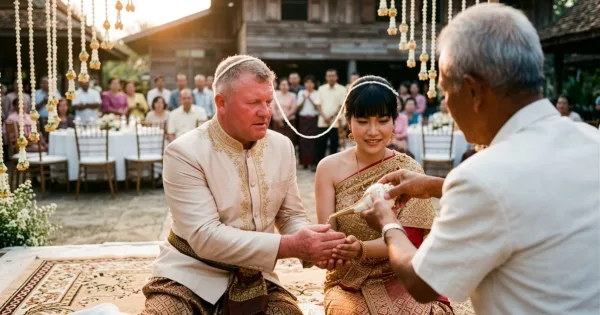
350 guests, a village chief consulting his charms for the date, and years later a message asking for a divorce.
A 50-year-old Australian recounts how a 350-guest Thai wedding in Phuket turned into a guest house in Patong, an affair with another woman, bar fights involving the police, and a final message asking for a divorce.
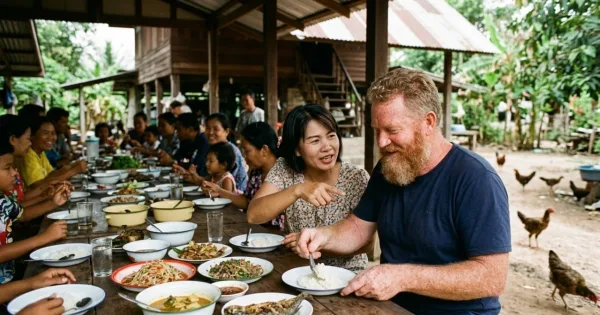
I went to Thailand on holiday after an eleven-year breakup in Scotland. Nineteen years later, I live with twelve in-laws under one roof.
Graham, a 51-year-old Scot, first came to Thailand at 32, on holiday after a long breakup. In the bars of Koh Samui he met Dao, the woman he'd later marry. Nineteen years, a Thai wedding, and a house built in Isaan later, he lives surrounded by her family and wouldn't change a thing.
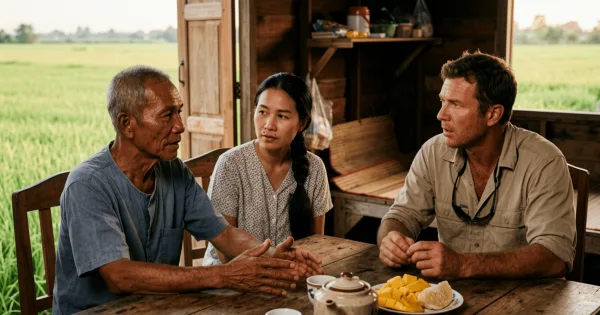
I assumed the prenup would be my idea, to protect myself. Her father sat me down at the table and explained it was the other way around: it was to protect his daughter's rice land.
Simon, a 45-year-old Australian, assumes that if there's a prenuptial agreement, it'll be his idea, to protect himself. His future father-in-law explains he actually wants the agreement to protect family land that's stayed in his daughter's name for generations.

I followed her one day instead of believing her story about the family visits. She didn't go to the bus station — she walked into a hotel with another man.
Retired in Pattaya since 2017, a 55-year-old Polish man falls for Apple, a 32-year-old bar girl with three kids to support. For months he believes he's the only man helping her out financially. One day he decides to follow her instead of believing the usual excuse, and discovers he was just one of several sponsors supporting her at the same time.
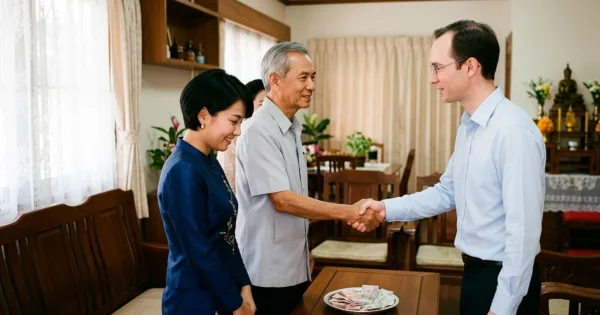
She was the perfect wife for eleven years. Then she used the visa, the custody courts, and social services to walk away with everything.
A British engineer married Knock, a woman from a respectable Bangkok family, and for eleven years she was the perfect wife. Once they moved to the UK on a spouse visa that cost two years and a fortune, everything changed: total control of the money, a women's shelter, a custody battle, and an ending he never saw coming.