Why do Thai girlfriends ask for money?
In short
In most cases, a Thai girlfriend asks for money because she maintains active financial responsibility toward her family, a common cultural obligation especially if she's from a region like Isaan. The key difference from a scam is transparency: a legitimate request is clearly explained and doesn't demand urgency or secrecy.
More context
In Thailand, especially in families of rural background, it's normal for adult children — daughters in particular — to send money regularly to their parents, something many women keep doing even after partnering with a foreigner. On top of that, there's the sin sod tradition, the dowry a bride's family may expect before a wedding. Neither of these automatically makes the relationship self-interested: they're part of the economic and cultural context it develops in. The problem arises when requests lose that usual transparency: amounts that grow without explanation, sudden emergencies, or resistance to talking openly about it.
Related questions
Does the request for money usually come directly from her, or through her family?
It varies: sometimes she raises it herself, other times a family member contacts the foreign partner directly. Neither channel alone signals a scam or a legitimate need — the same warning signs described on this page apply either way.
How much money is reasonable to send?
There's no universal figure: it depends on the foreigner's income and the family's real needs, but it should be an agreed, sustainable amount, not escalating one-off requests.
When does asking for money become a red flag?
When requests are urgent, repeat without clear explanation, or come with resistance to verifying the relationship through video calls or an in-person meeting.
Related stories
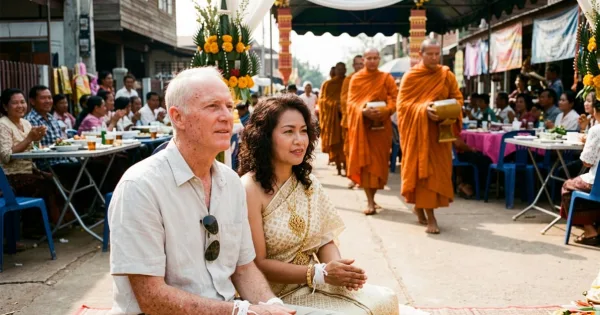
I opened a joint account with the million-baht dowry. She started quietly withdrawing money without telling me.
A 62-year-old retired American recounts how he met Dada at a Pattaya massage shop, married her in a Buddhist ceremony in Isan, and everything fell apart when she started quietly withdrawing money from the joint account he'd opened for the dowry.
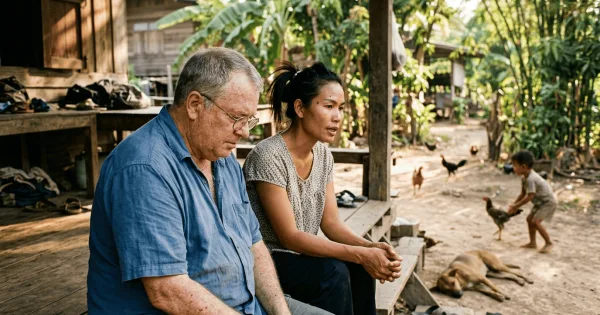
She called it being her boyfriend. Over time I realised I was actually her sponsor, one of several.
A recently retired American looks back on his relationship with a Thai woman he met in Hong Kong. What began as a romance with visits to Bangkok turned into a growing list of monthly payments, until he discovered he wasn't the only man supporting her.

I'd been going to Thailand for fifteen years and thought I knew it all. One game of pool in Pattaya proved me wrong.
At 39, an Australian who considered himself a seasoned Thailand traveller met a girl over a game of pool in a Pattaya bar. Ten perfect days, a golf tournament in Indonesia, visits to her family in Isaan. All good until six months of distance for work uncovered that the Scottish boyfriend she said she'd left had never actually gone anywhere.

He almost sent 400,000 baht. The only good decision he made was not to.
A 41-year-old British man went in two weeks from a Soi 4 fling to talking dowry and house renovations. He almost sent 400,000 baht. He did not.

An Australian messaged me to say the woman I'd fallen for was his girlfriend of a year. Today she's my wife.
At 44, divorced for a decade, an American meets Tay on Facebook. A month later, already in love, he finds out she'd spent the past year with an Australian man who'd visited her village in Isan. She confesses everything honestly and asks for one chance. Years later, they're married and building a house to retire in.